
Why Authentic Mexican Flavor is Built on Dried Chilies
In the culinary universe, few ingredients are as profoundly misunderstood as the chili pepper. To the uninitiated, the chili is simply a mechanism for heat—a spicy lever to pull when you want your meal to burn. This misunderstanding has led to the proliferation of industrial "hot sauces" that are engineered for pain, sacrificing complexity for a momentary shock to the system.
But here at Papi's Tacos, we know a deeper truth. We know that the chili, particularly the dried chili, is the very heart of authentic Mexican flavor. It is a spice, an herb, a vegetable, a thickener, and a colorant, all wrapped into one delicate, powerful package.
To Chef Mauricio, the dried chili is not a dare; it is a declaration of depth.
If you want to move beyond simple "spicy" and truly understand the soul of salsa, you must understand the magic that happens when a fresh pepper surrenders its water and gains a thousand years of culinary complexity.
This is the definitive guide to the essential, complex world of dried chilies.
Part I: The Misconception and the Culinary Philosophy
The biggest culinary crime against the chili is treating it as a one-dimensional ingredient.
The Problem with "Hot Sauce" Culture
Most commercial hot sauces are built on a chemical axis: vinegar, salt, and heat (usually from super-hot, fresh chilies like Habanero or Scotch Bonnet). They are designed to be bottled quickly and deliver an intense, singular sensory experience. While exciting, they flatten the flavor profile of the dish they are added to.
The Core Philosophy: Flavor Over Fire
Authentic Mexican cuisine operates on an entirely different plane. The chili is used as the base of the sauce, providing foundational notes: smoky, earthy, fruity, chocolatey, or acidic. The heat (picante) is present, but it acts merely as a spotlight to illuminate the layers of flavor.
"If your salsa only makes you sweat, we failed. If it makes you close your eyes and taste the sun, we succeeded. We are cooks, not torturers." – Chef Mauricio
The secret to achieving this depth is allowing the chilies to fully mature on the vine and then drying them. The drying process is not just preservation; it is flavor concentration and evolution. Just as drying a grape concentrates its sugar and flavor complexity into a raisin, drying a pepper transforms its essential characteristics, making it an entirely new, sophisticated ingredient.
Part II: The Alchemy of Drying and Toasting
The journey from a fresh, snappy pepper (chile verde) to a complex, leathery dried pepper (chile seco) is the first step of alchemy. The second step is the ritualistic preparation required before it hits the blender.
1. The Transformation: Fresh vs. Dried
The most important rule in Mexican cooking is that the name of a fresh chili is often different from its dried form, reflecting its changed identity:
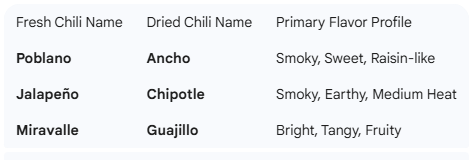
This linguistic change emphasizes that they are functionally different ingredients. A dried Ancho is used to thicken and sweeten a Mole; a fresh Poblano is typically roasted and stuffed.
2. The Preparation Ritual: The Comal’s Kiss
The single most crucial step that separates authentic, flavorful salsa from a flat, home-cooked attempt is the toasting (or dry-roasting) of the dried chilies before soaking them.
Before the chilies are soaked in hot water, they must be briefly toasted on a dry, heavy comal (griddle) or skillet.
The Science: This quick application of high, dry heat achieves two goals: 1) It completely evaporates any remaining moisture, and 2) It gently toasts the oils and trace sugars in the pepper wall. This process is called Maillard reaction, which deepens the smoky aroma and releases the essential oils that contain the profound, complex flavors.
The Mistake: If you skip this step, the salsa will taste raw, flat, and sometimes bitter. The beautiful, complex profile remains locked inside the un-toasted pepper.
After toasting (usually for less than 60 seconds per side), the chilies are soaked in hot water to rehydrate them, making them pliable and ready to blend into a smooth, thick paste.
Part III: The Essential Dried Chili Taxonomy (The Big Four)
To truly cook Mexican food, you need to understand the personality of the four most essential dried chilies. Each has a specific job in the sauce and should be respected accordingly.
1. The Guajillo: The Fruity Workhorse
Appearance: Long, wide, and leathery, with a smooth, glossy red skin.
Flavor Profile: Low to medium heat. The flavor is bright, tangy, slightly sweet, and distinctively fruity (often compared to dried cranberry or berry).
Usage: The Guajillo is the workhorse of the Mexican kitchen. It provides vibrant red color without delivering excessive heat. It is essential for Adobos (marinades), Pozole, and many mild table salsas. It’s the chili that gives sauces depth and color without demanding a glass of milk.
2. The Ancho: The Smoky Sweetheart
Appearance: Wide, dark red to almost black, with a wrinkled skin. It is the dried form of the Poblano pepper.
Flavor Profile: Low to medium heat. The flavor is rich, smoky, raisiny, and subtly sweet, with a hint of dark chocolate or coffee.
Usage: The Ancho is used to provide richness and body. Its sweetness perfectly balances the tanginess of the Guajillo in many recipes. It is indispensable in Moles and in making thick, dark, and complex sauces where heat is secondary to depth.
3. The Pasilla: The Raisin-y Complex
Appearance: Long, thin, and dark brown-black. Its name means "little raisin," referring to its wrinkled texture.
Flavor Profile: Medium heat. It offers a subtle, earthy, complex flavor profile that often includes notes of cocoa and dried fruit, but with less sweetness than the Ancho.
Usage: Often used in combination with Ancho and Guajillo (the holy trinity of dried chilies). It provides a necessary earthy, back-of-the-palate complexity, crucial for traditional enchilada sauces and savory, complex Moles.
4. The Árbol: The Heat Keeper
Appearance: Small, thin, and bright red, often retaining its color when dried.
Flavor Profile: High heat. Unlike other chilies, the Árbol is used specifically for its sharp, clean, bright heat. It doesn't offer the deep, smoky complexity of the others.
Usage: It’s often used in table salsas (Salsa Taquera or Salsa Macha) alongside other chilies. It provides the final kick needed to cut through the fat of a taco without muddying the smoky flavors of the larger, darker peppers.
Part IV: The Final Assembly and The Papi’s Promise
When the dried chilies are toasted, rehydrated, and blended with roasted fresh ingredients (like tomatoes or tomatillos, garlic, and onion), they transform into a salsa that provides essential contrast to the meal.
The Purpose of Pairing
A great taco requires two opposing flavor forces:
Richness and Umami: Delivered by the slow-cooked meat (fat, gelatin, hours of seasoning).
Pungency and Acid: Delivered by the salsa (chili, lime, and fresh tomato/tomatillo).
If the chili base is complex and earthy (Ancho/Pasilla), it’s perfect for the rich darkness of beef Barbacoa. If the salsa base is tangy and bright (Guajillo with Tomatillo), it’s the perfect foil for the sweetness and fat of Al Pastor.
This thoughtful assembly is what defines authentic Mexican flavor. It is a commitment to precision where every ingredient, especially the humble dried chili, pulls its weight, ensuring that the salsa is never just an afterthought—it is the electric spark that brings the entire dish to life.
At Papi's Tacos, our commitment to drying, toasting, and blending these essential chilies is the secret ingredient you can taste in every single spoonful. It's the promise that your salsa will be complex, balanced, and always, authentically, delicious.
About Us: At Papi's Tacos, we are inspired by both the authentic street culture and the culinary evolution sweeping Mexico. We commit to using traditional masa and slow-cooking techniques to deliver a flavor that is both deeply traditional and undeniably fresh. Come taste the future of Mexican food with us. ¡Buen provecho!